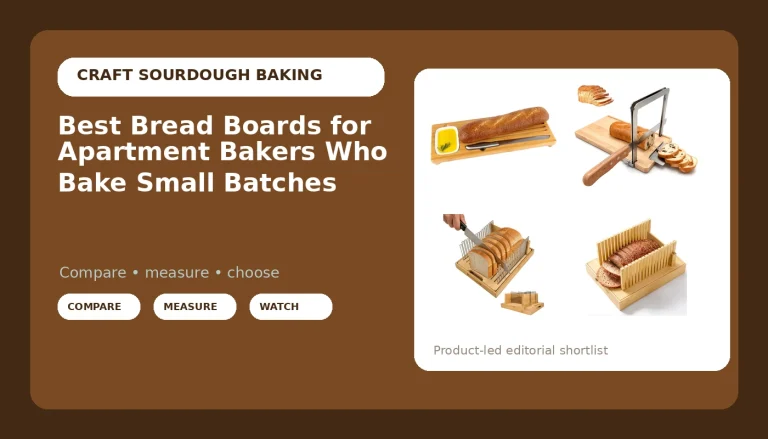
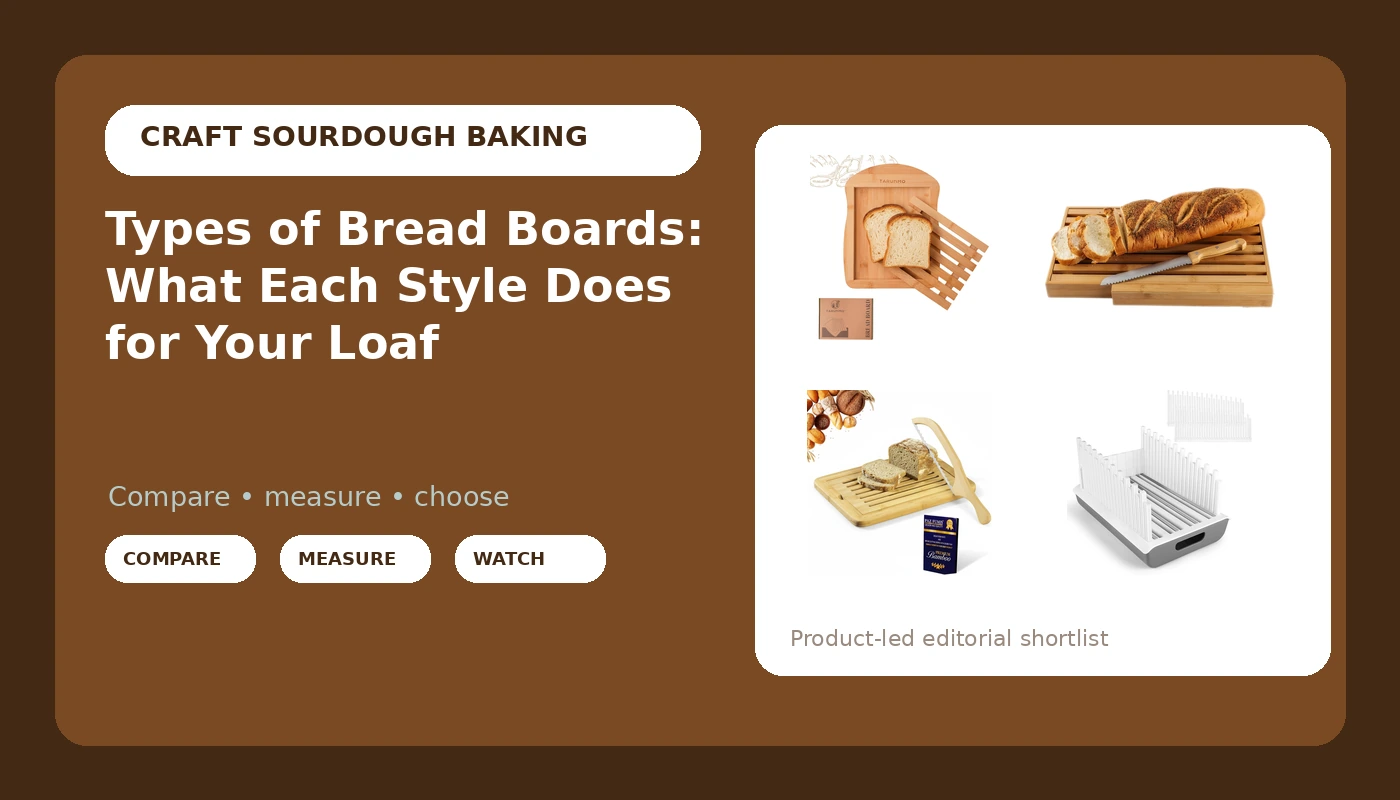
Slicing a loaf you baked yourself is where a good bake can still go wrong. The crust drags, the crumb compresses under the knife, and the first slice comes out wedge shaped while the rest collapse into slabs. The types of bread boards worth owning are not defined by the wood they are cut from. They are defined by three jobs: holding the loaf still, catching the crumbs, and controlling how thick each slice comes out. A board that does none of those is a serving platter with extra steps, and a guide that does the third job badly is worse than a steady hand. What follows is a functional map of the options, plus the five shapes those options take in the listings worth a second look.
Quick answer
The types of bread boards that matter for a home baker fall into two families. A crumb tray board gives you a stable cutting surface with a drawer, channel, or removable tray underneath to catch what falls. An adjustable slicing guide holds the loaf square and sets the width of each slice. Complete sets bundle a board, a tray, and a knife. If your problem is mess, buy the tray board. If your problem is ragged, uneven slices, buy the guide. If it is both, buy the set, and accept that the bundled knife is the part most likely to be replaced first.
Five useful options
| Model | Best fit | What stands out |
|---|---|---|
| Bamboo Bread Board with Crumb Tray, 13 x 10 Inch | Small kitchens, single loaves | Compact 13 x 10 inch bamboo board with a crumb tray |
| Large Bamboo Bread Cutting Board, Knife, Crumb Tray, Christmas | Gifting, or a first slicing setup | Larger bamboo board with a knife and crumb tray, boxed as a Christmas set |
| Bread Cutting Board set with bow knife and crumb tray holder | Thin, even slices from one station | 15 x 9.5 inch board, 16 inch bow knife, tray with its own holder |
| Bread Slicer for Homemade Bread, Adjustable Width Slicing Guide | Bakers who already own a board | Adjustable width guide, board not included |
| NiHome Bread Slicer for Homemade Bread, Bamboo, Adjustable Thickness | Sandwich loaves and repeatable thickness | Bamboo slicer body with adjustable thickness |
The compact board: Bamboo Bread Board with Crumb Tray, 13 x 10 Inch
The appeal here is footprint. At 13 x 10 inches this is the smallest board in the group, which matters in a kitchen where the board lives on the counter rather than in a cupboard. A boule of moderate size sits comfortably; a long batard will overhang one end and you will end up rotating the loaf mid slice. The crumb tray is the reason to pick it over a plain board, since crust shards and flour land in the tray instead of spreading across the counter. Keep expectations calibrated: a tray catches what falls directly beneath the cut, not the flour you knocked off while loading the loaf, and nothing saves you if you saw at the bread instead of drawing the knife through it. Bamboo is dense and forgiving under a serrated edge, but it wants hand washing and a dry rack, not a soak.
The large board with knife: Large Bamboo Bread Cutting Board, Knife, Crumb Tray, Christmas
Gift framing is doing a lot of work in this listing, and that is not a criticism. A large bamboo board, a bread knife, and a crumb tray in one box is a sensible present for someone who has just started baking, because it covers the whole job in a single purchase. The trade-off is the knife. Bundled knives are usually the first thing a baker replaces, and if you already own a serrated knife you like, you are paying for a duplicate to get the board and tray. Judge the listing on the board and tray first, then treat the knife as a bonus. The real upgrade over a compact board is surface area: a full length batard fits, and you have room to set the loaf down, turn it, and cut without chasing it around the edges.
The complete slicing station: Bread Cutting Board set with bow knife and crumb tray holder
This is the most complete of the sets: a 15 x 9.5 inch board, a crumb tray with its own holder, and a 16 inch bow knife. A bow knife is built to cut on the pull, with the blade held under tension and set at a fixed distance above the board, which is why it is associated with thin, even slices rather than torn ones. That fixed geometry is also the limitation. It suits sandwich slicing and serving; it is not the tool for splitting a boule horizontally or trimming a domed top. Note the board proportions: longer but narrower than a 13 x 10 compact board, so a very wide loaf will hang over the sides. The tray holder is a small thing until you have chased a tray of crumbs across the counter between cuts.
The adjustable guide: Bread Slicer for Homemade Bread, Adjustable Width Slicing Guide
A guide is not a board, and that distinction saves money or wastes it depending on what is already in your kitchen. This one is an adjustable width slicing guide: you set the spacing, the loaf sits against it, and the knife follows the fence instead of your eye. Pair it with a board you already own and you have most of the function of a slicing set for less money and less storage. The trade-offs are real. A guide only works if the board underneath is flat and the guide stays put, so a warped board or a slick surface undermines it. Adjustable width is genuinely useful in a household that wants thick toast slices one day and thin sandwich slices the next. It does nothing about crumbs, which still land on the board and the floor.
The bamboo slicer: NiHome Bread Slicer for Homemade Bread, Bamboo, Adjustable Thickness
Bamboo body, adjustable thickness, slicer rather than board. This is the option for someone whose loaves come out of a standard loaf pan and who wants consistent thickness without freehanding a knife. Adjustable thickness is the feature that matters: set it once for sandwiches, once for toast, and stop guessing at the width. The thing to check before buying is internal clearance. A slicer has to accept the full height and width of your loaf, and a tall sandwich loaf or a wide sourdough batard can simply not fit. Compare the opening to your pan dimensions rather than to a photograph of a neat bakery loaf. Bamboo is a sensible material here because it is stable, though it still wants hand washing and thorough drying. If your loaves are irregular, an open guide is more forgiving than an enclosed slicer.
Prices and availability may change. Product images, names, and retailer links must be matched by verified ASIN. Do not state a current price, rating, stock status, or measured result without current evidence.
The types of bread boards, grouped by function
Sort the market by what the object does rather than by what it is called, and four groups appear.
A flat board is just a surface. It is fine for serving and for cutting a loaf you intend to eat within the hour, but nothing on it holds the bread still and nothing catches the debris.
A crumb tray board adds a drawer, channel, or removable tray under the cutting surface. The point is not neatness for its own sake. Crumbs under the loaf make it slide, and a sliding loaf is how you get a wedge shaped first slice. Tray capacity varies more than photographs suggest, and a shallow tray on a small board fills fast.
An adjustable slicing guide controls thickness. These come as fences that sit over your own board and as enclosed slicers that hold the loaf on both sides. The enclosed version gives more control and less forgiveness: if the loaf does not fit, it does not fit.
A complete set bundles board, tray, and knife. Sets save decisions and usually cost less than buying three pieces separately, at the price of accepting someone else's knife.
Material matters less than people expect. Bamboo is dense, stable, and less prone to soaking up moisture than open grained hardwood, which is why it dominates this category, but it still should not go in a dishwasher. Blade depth is the spec nobody lists: a long serrated knife or a bow knife needs clearance above the board, and a guide with deep slots accepts only certain blades. If the loaf itself is still the problem, start with shaping tension rather than with equipment. A board cannot rescue a loaf that never had structure.
How to choose bread boards for the loaf you actually bake
Most buying mistakes here are size mistakes. A board bought for the loaf in a photograph is often too small for the loaf in your kitchen. Decide the primary problem first, crumbs or thickness, then work through five checks.
- Measure the loaf, not the pan. A boule and a batard of the same dough weight occupy very different footprints.
- Check the board against your longest loaf. A board narrower than the bread means rotating mid cut, which is where uneven slices come from.
- Check knife clearance and blade depth. A bow knife or a long serrated blade needs room above the cutting surface and a guide that accepts its thickness.
- Check tray capacity and cleaning. A removable tray that rinses in the sink beats a fixed channel you dig flour out of with a brush.
- Decide set or separate. If you own a board you like, a guide is the cheaper addition; if you own neither, a set avoids buying twice.
That order matters because the first two checks eliminate most listings before price or finish becomes relevant.
Practical checks before you buy
- Reading bread boards reviews is useful for exactly one thing: finding the repeated complaint. A tray that rattles, a guide that slips, a finish that lifts at the rim. Ignore the star average and read for the pattern.
- Any bread boards buying guide that opens with wood species is starting in the wrong place. Start with loaf size and knife, then work back to material.
- A list of top rated bread boards tells you what other people bought, not whether the opening fits your pan. Popularity is not fit.
- If you are shopping for bread boards for beginners, skip the set with the most parts and take the simplest tray board you can find. Extra pieces are the ones that end up in a drawer.
- Hunt for best budget bread boards by function, not by price alone. A plain board with a decent tray beats a cheap slicer that will not accept your loaf, whatever the listing promises.
Cleanup is the hidden cost. Bamboo wants hand washing, thorough drying, and an upright spot to store, and a board that lives in a cupboard has to be light enough to lift out with one hand.
Which option should you choose?
Choose the Bamboo Bread Board with Crumb Tray, 13 x 10 Inch when counter space is tight and your loaves are moderate in length. Choose the Large Bamboo Bread Cutting Board, Knife, Crumb Tray, Christmas when you want a bigger board in one purchase, or a gift that covers the whole job. Choose the Bread Cutting Board set with bow knife and crumb tray holder when thin, even slices matter and you want slicing and serving handled at one station. Choose the Bread Slicer for Homemade Bread, Adjustable Width Slicing Guide when you already own a board you trust and only need thickness control. Choose the NiHome Bread Slicer for Homemade Bread, Bamboo, Adjustable Thickness when your loaves come from a standard pan and you want a repeatable set thickness.
None of this is a measured comparison. The distinctions above come from what the listings state about size, material, and included parts; the fit judgments are inference from dimensions, and your own loaf is the only test that counts. Check the interior and cutting dimensions against a loaf you have actually baked before you buy.
The bottom line
The types of bread boards that earn their counter space are the ones that solve the problem you actually have. Crumbs are a board problem, uneven slices are a guide problem, and most home bakers have both after the first year. Buy the tray board if you are starting out, and the guide or the slicer if your slices are already the complaint. Bamboo, hand washed and dried upright, will outlast the knife that came in the box, and that knife is the part you should expect to replace first.