A baguette runs 22 to 26 inches from tip to tip, and that single measurement is what makes shopping for bread boards for baguettes different from shopping for any other board. A 12-inch cutting board forces you to saw at an angle with half the loaf hanging off the edge, and the crumb shears wherever the blade stops being level. Length comes first, then the guide, then the wood. The shortlist below is the best bread boards for baguettes I would put in front of a baker right now: one long board cut to the shape of the loaf, four slicing guides that hold a loaf steady while the knife travels, and one large board that arrives with a knife and crumb tray in the box. Everything here is compared on published dimensions, materials, and included parts, not on a test bench I never stood at.
Quick answer
The Totally Bamboo Palaoa Bread Serving & Cutting Board is the strongest fit for baguettes because its 23 by 6 inch surface is the only one in this group shaped like the loaf itself: long enough for a full baguette, narrow enough that the crust stays supported end to end. Choose the Acacia Wood Bread Slicer with Bread Knife instead when you want the loaf cradled in a slotted guide with a knife included in the same box.
Bread boards for baguettes worth comparing
Two different tools get sold as bread boards, and a baguette exposes which one you actually need. The first is a flat board with real length: no slots, no drawer, just a surface long enough to hold the whole loaf while you cut and to carry it to the table afterwards. The second is a slicing guide, a slotted frame with a base, a crumb tray, and sometimes a knife, and its job is repeatable thickness rather than support. A guide sized around a round boule will not hold a baguette without the ends overhanging. A long flat board will hold the loaf but leaves slice thickness to your eye and your scoring angle. Most bakers eventually want one of each, and the list below is ordered with that split in mind.
Top pick
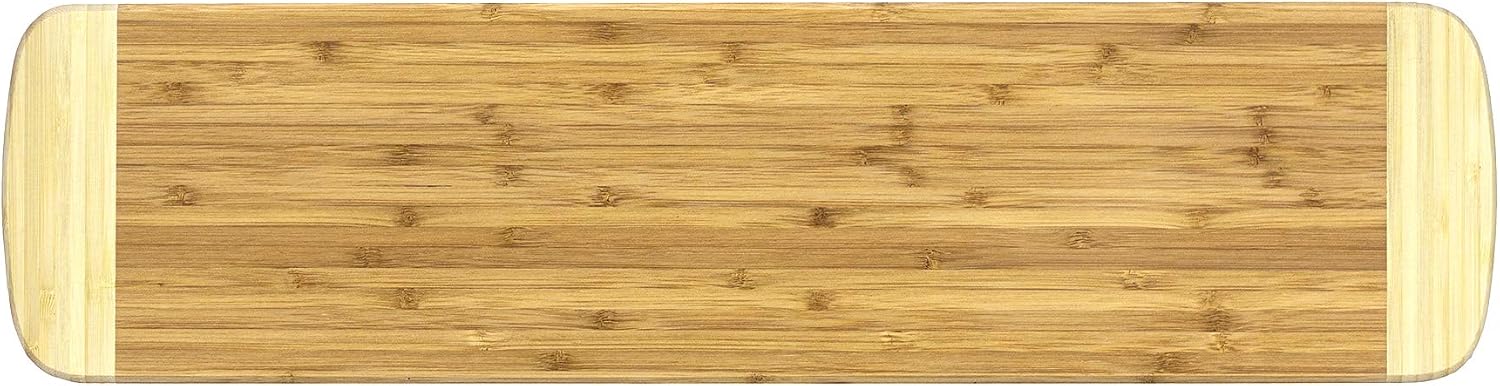
Totally Bamboo Palaoa Bread Serving & Cutting Board, Great for Charcuterie and Appetizer Spreads, 23" x 6"
A 23 by 6 inch bamboo board for serving and cutting. The length takes a full baguette and the narrow width keeps the loaf from sliding; no slot, no tray, no knife.
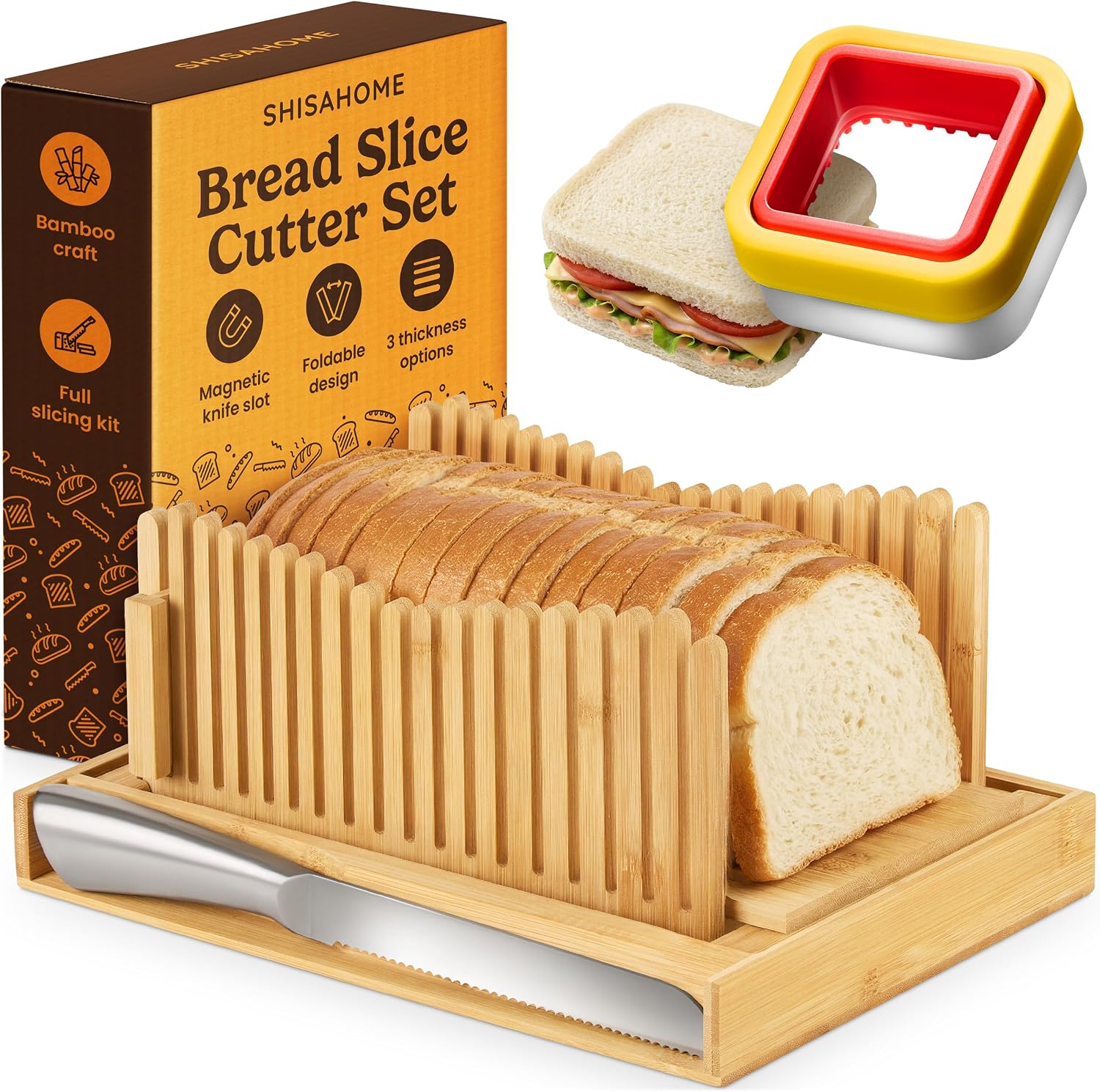
Bread Slicer Guide for Homemade Bread 2-In-1 Set: Sourdough Rounds Slicer, Sandwich Sealer | Bread Loaf Slicing, Adjustable Bamboo Bread Cutter With Knife & Magnetic slot
An adjustable bamboo cutter with a knife, a magnetic slot, and a sandwich sealer in the same set. Sold as a two-in-one for sourdough rounds and loaf slicing.
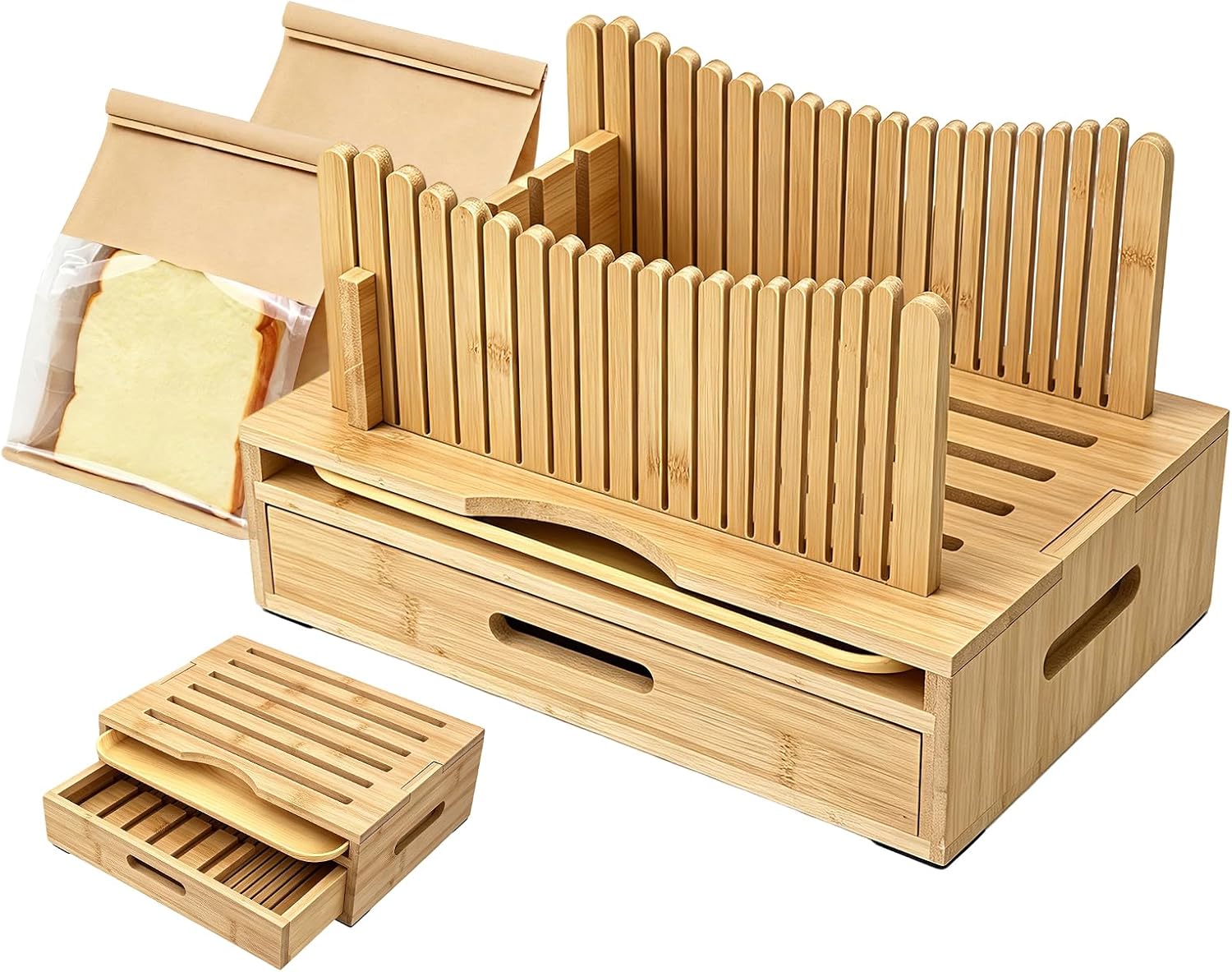
Bamboo Bread Slicer for Homemade Bread, Storage Drawer 2 Bread Bags
A bamboo slicer with a pull-out storage drawer and two bread bags included. The drawer catches crumbs; the bags take the loaf once it is cut.
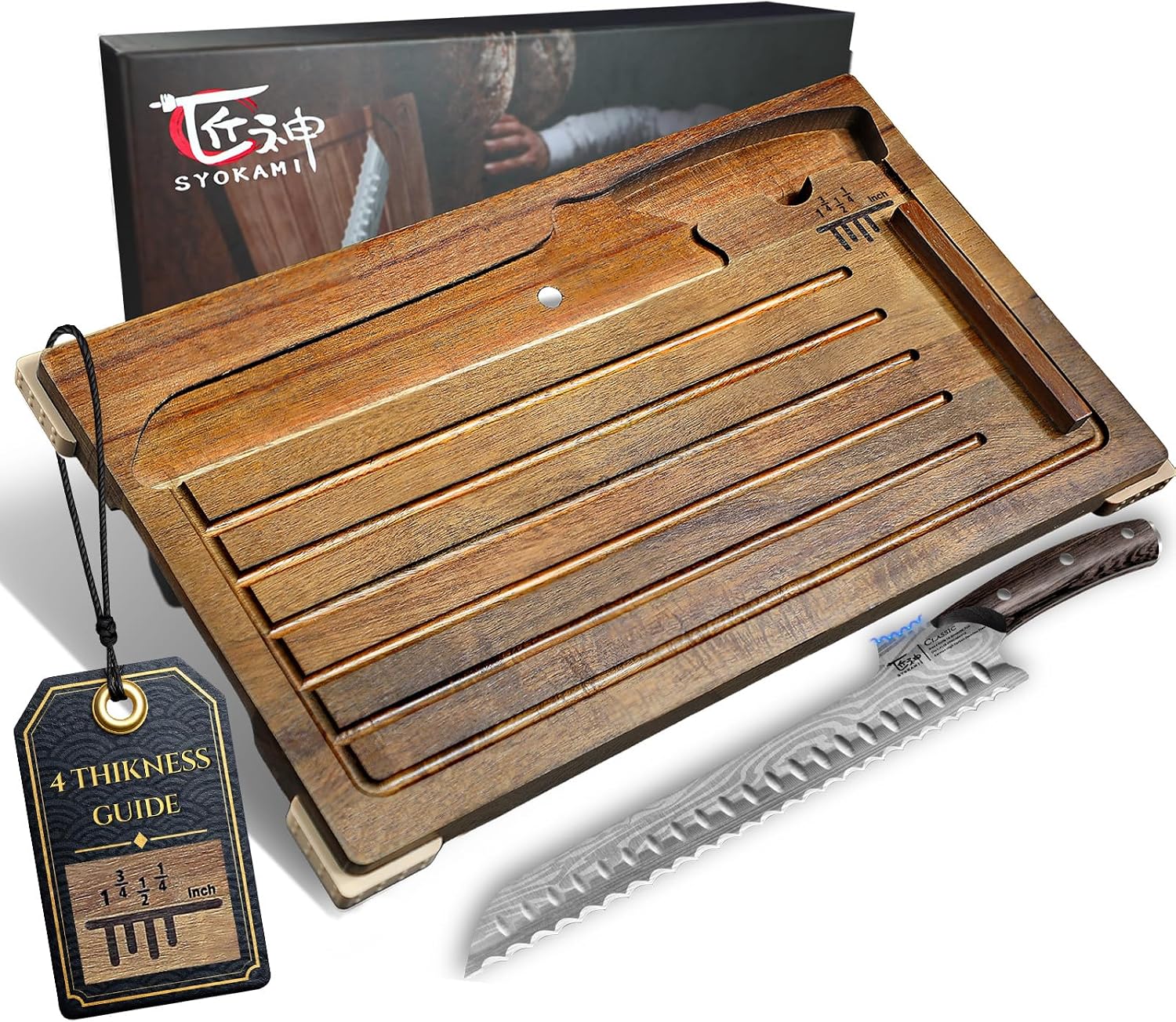
Acacia Wood Bread Slicer with Bread Knife, Bread Board Bread Cutter
An acacia hardwood slicer with a bread knife in the box. Heavier and harder than bamboo, and the one option here built from a denser wood.
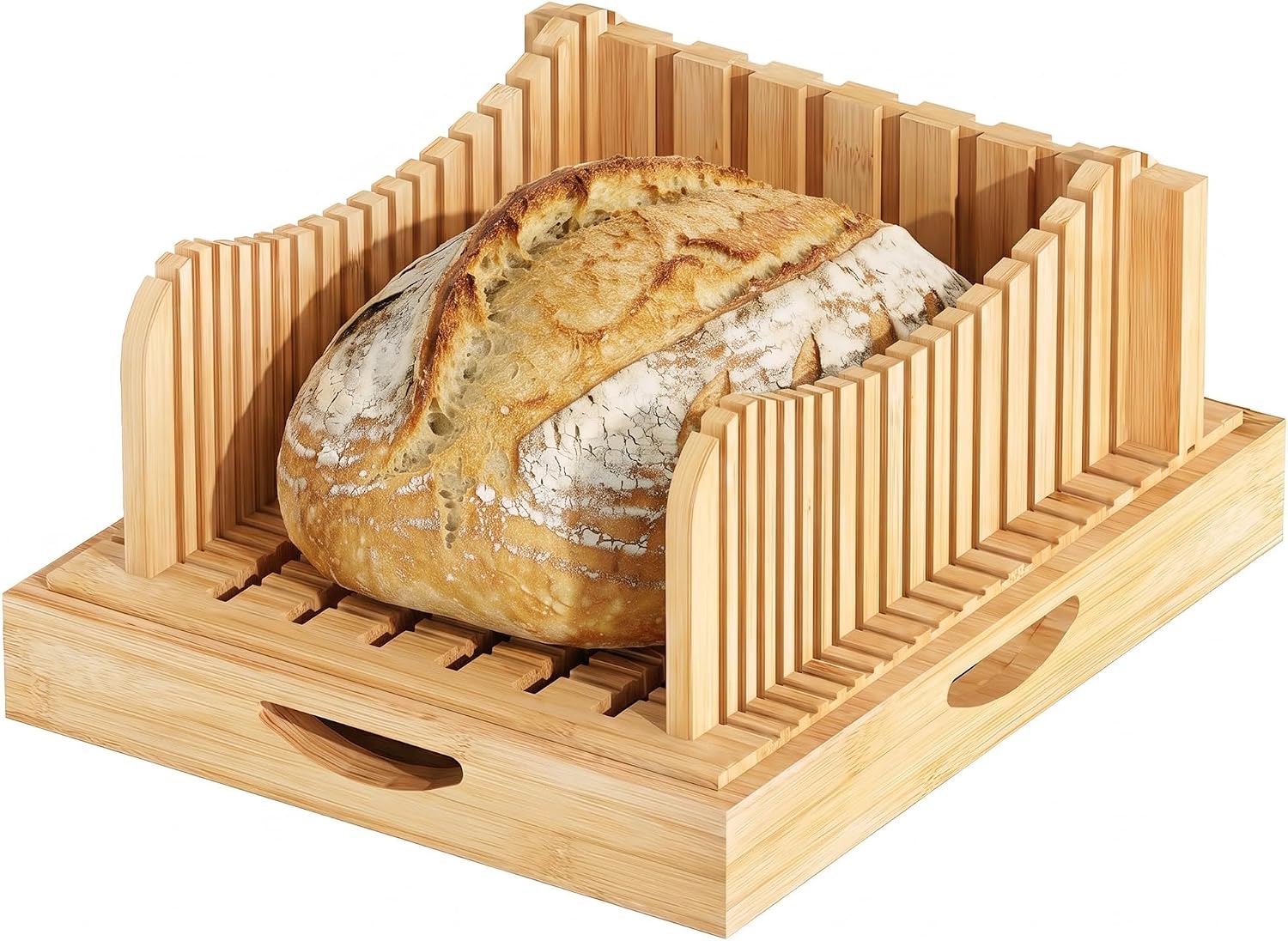
11" Extra Wide Bamboo Bread Slicer for Sourdough Homemade Bread
An 11 inch extra wide bamboo guide aimed at sourdough and homemade bread. The width suits boules and sandwich loaves rather than long loaves.
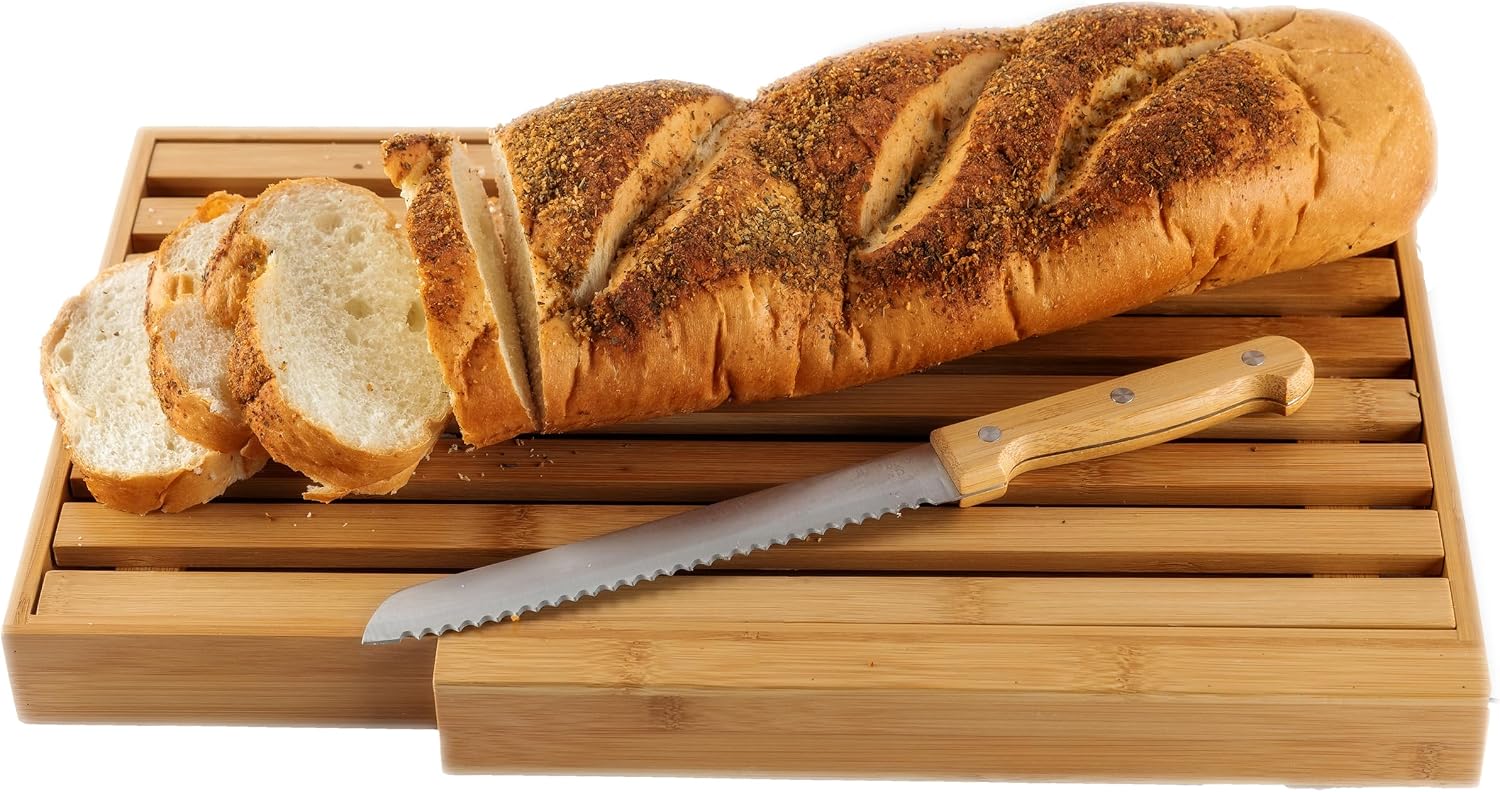
Large Bamboo Bread Cutting Board, Knife, Crumb Tray, Christmas
A large bamboo cutting board that ships with a knife and a crumb tray. Board first, slicing aid second, with no adjustable fence.
How these products were compared
Five things decide a baguette board, and none of them is the copy at the top of the listing. The first is usable length and width, because a 23 by 6 inch board and an 11 inch extra wide guide solve different problems and both are correct for the shape they were built around. The second is guide adjustability, since a fixed slot cuts one thickness while an adjustable fence lets you move from a thin sandwich slice to a thicker tranche for toast. The third is crumb containment, which means a tray, a drawer, or a base with a lip rather than an open frame that dusts the counter. The fourth is material and care: bamboo is dense, affordable, and thirsty for oil, while acacia is a harder, heavier hardwood with a slightly different maintenance rhythm. The fifth is what ships in the box, because a bread knife or a pair of bread bags changes what you still have to buy.
Bread boards reviews tend to skip the boring part, which is fit. A slicer listed as suitable for homemade bread can still be short for a 26 inch baguette, and a long board can still be too wide for a 1 kg boule. The top rated bread boards on a retailer page are ranked by a mix of things that have nothing to do with a long loaf. So I read the dimensions as the first filter and the material as the second, and I will say plainly that this is a comparison of published product data rather than a hands-on bake-off: no loaf in this article was cut on a board I do not own. What the listings do support, they support well, and that is material, overall dimensions, whether a knife or storage drawer is included, and which loaf shapes the maker says the guide suits.
How to choose the right bread board
A bread boards buying guide usually opens with wood species. This one opens with a tape measure, because length is the spec you cannot work around. Measure the longest thing you actually bake: a baguette at 24 inches, a batard at 12, a boule at 9 or 10 across. A board needs an inch or two of margin beyond that number, so a baguette baker is shopping for roughly 26 inches of length while a round-loaf baker is shopping for 12 inches of width. If you bake both, buy for the longer shape, because a long board handles a boule perfectly well and a short board cannot be stretched. For bread boards for baguettes, narrow beats wide every time: 6 inches of width supports the loaf without letting it roll, and anything past 10 inches is board you are storing rather than using.
Then decide whether you want a slot. A slotted guide buys consistency, since the knife travels in a fixed plane and the loaf cannot slide, and what it costs is flexibility, because the fence sets your blade depth and a baguette with a hard, blistered crust wants a longer, lighter stroke than a soft sandwich loaf. Look for a guide that adjusts rather than one offering two fixed positions, and check that the base is long enough that a 24 inch loaf does not hang off both ends. A flat board has none of those limits and none of that help. Your slice thickness comes from your eye, which is fine for serving at the table and less fine across a week of toast.
Crumb handling is the difference between a board you use daily and one that ends up in a cupboard. A tray or a pull-out drawer under the slot catches what falls; an open frame drops it on the counter. If you bake three times a week, the drawer version earns its bulk. If the board lives on the counter and doubles as a platter, a flat board is easier to wipe and looks better with cheese on it. Material comes last: bamboo is dense and stable, which is why most of this list is bamboo, and it wants mineral oil rather than soap and water. Acacia is heavier and harder and will show knife marks more slowly, at the cost of weight. Neither belongs in a dishwasher and neither should soak. If your loaves are spreading rather than standing, the board is not the problem, and the banneton size guide for a 1 kg boule is the more useful read on dough strength and shaping tension.
Totally Bamboo Palaoa Bread Serving & Cutting Board, 23 by 6 Inches
The Palaoa is a 23 by 6 inch bamboo board sold for serving and cutting, for charcuterie and appetizer spreads, and the baguette case is the happy accident of that shape. Twenty-three inches takes a full-length loaf with a little margin at each end. Six inches holds the width of a baguette or a batard without leaving a wide runway for the loaf to slide across. That combination is rare here, because most slicers are built around a round boule and most flat boards are built around a chicken.
Because it is a serving board first, it has no slot, no drawer, and no knife. You cut where you like and you carry the board to the table, which is how a baguette actually gets eaten: sliced on the board, buttered on the board, gone before it reaches a basket. Bamboo is dense enough for daily knife work, and the long grain runs with the loaf, so the blade is not crossing end grain on every stroke.
The trade-off is consistency. Without a fence, slice thickness is a skill, and baguette crust is unforgiving: a sawing motion through the blistered top compresses the crumb underneath before the blade reaches it. The 6 inch width also means a fat batard or a 1 kg boule overhangs, so this is not the one board for every loaf you bake. Like every bamboo surface here it needs hand washing, a periodic coat of mineral oil, and it will show cut marks. What it does not need is a second tool to hold the loaf, which is why it leads.
Alternatives to consider
The Bread Slicer Guide for Homemade Bread 2-In-1 Set is better suited to bakers who want repeatable thickness and a sandwich sealer in the same box, while the Bamboo Bread Slicer for Homemade Bread, Storage Drawer 2 Bread Bags is a stronger fit when crumbs and bag storage are the annoyances you want solved at once. The first pairs an adjustable bamboo frame and a magnetic slot with a knife, so the whole slicing setup arrives together. The second adds a pull-out drawer under the cutting surface and two bread bags, which is the more complete answer if you cut a loaf and then store half of it.
The Acacia Wood Bread Slicer with Bread Knife, the 11" Extra Wide Bamboo Bread Slicer for Sourdough Homemade Bread, and the Large Bamboo Bread Cutting Board, Knife, Crumb Tray, Christmas cover the remaining cases. The acacia slicer is the denser hardwood option with a knife included, and it carries more weight on the counter for it. The extra wide bamboo guide trades length for width, which is the right call for boules and square sandwich loaves and the wrong one for a 24 inch baguette. The large bamboo board is the hybrid: a big flat cutting surface with a knife and a crumb tray in the box, no adjustable fence, and the simplest cleanup of the group.
Day-to-day use and maintenance
Cut a baguette crust side up, holding the loaf with your fingertips on the far side, and let the knife do the work with a light sawing stroke rather than pressure. On a flat board, angle the loaf so the blade travels slightly across the long grain instead of straight down the centre; the slice holds its shape better and the crust shatters less. On a slotted guide, seat the loaf against the fence before the first cut and check that both ends are supported. A loaf that overhangs by three inches will tip on the last slice.
Empty the crumb tray or drawer after every session rather than every week. Sourdough crumbs are dry and they migrate, and a drawer left full will deposit a layer of dust on the counter the next time it is pulled out. Wipe the frame with a damp cloth and dry it immediately. Bamboo and acacia are both hand wash only, and neither should sit in water or go through a dishwasher cycle, which is the fastest way to split a glued board at the seam. A light coat of mineral oil every month or two keeps the surface from drying and keeps knife marks from turning grey.
If your slicer folds, dry it open rather than closed so air reaches the hinge. If it ships with a bread knife, keep the knife out of the drawer and wash it by hand too; the serrations hold crumbs and the blade dulls against other metal. Bread bags that come with a slicer are reusable for a few weeks of loaves, and a bag that has held a fresh loaf will trap moisture, so shake the crumbs out and let it air dry between uses.
Buying checklist
- Measure the longest loaf you bake and add margin at both ends: a baguette baker needs about 26 inches of board, a boule baker needs about 12 inches of width.
- Choose flat board or slotted guide based on normal use rather than an occasional edge case; if most weeks are baguettes, length beats a drawer.
- Confirm that the exact model includes the knife, bread bags, or crumb tray shown in the listing photos.
- Read the cleaning and maintenance instructions; bamboo and acacia are hand wash and oil, never dishwasher.
- Verify the current retailer price, availability, and return terms before ordering.
Final recommendation
Choose the Totally Bamboo Palaoa Bread Serving & Cutting Board when you want one board that holds a whole baguette, cuts it, and goes to the table, and you are willing to set slice thickness by eye. Choose the Acacia Wood Bread Slicer with Bread Knife when you want the loaf held in a guide with a knife in the box and you would rather have weight and hardness than a lighter board. If you bake round boules more often than long loaves, the extra wide bamboo guide is the better geometry; if crumbs are what bother you, the drawer model solves that specific problem. The one thing worth avoiding is a short board sold as a bread slicer: it will hold the middle of a baguette and nothing else.